


Description
The Liege Tourist Scavenger Hunt is a 3.1 km (1.9 mi) self-guided walking tour using your smartphone. Challenges await at almost every stop. It takes approximately 2 hours to complete. It finishes at the starting point.
- City Hall
- Saint-Denis Collegiate Church
- Saint-Étienne Place
- Théâtre Proscenium
- Saint-Lambert Place
- Prince-Bishops’ Palace
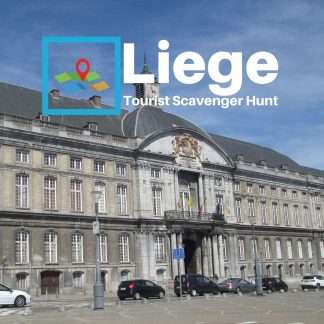
- Palais de Justice de Liège
- Walloon Life Museum
- Opéra Royal de la Wallonie-Liège
- Trocadéro de Liège
- Saint-Paul Cathedral
- Saint-Paul Place
We tested this rally in Liège in August 2025. Have fun!
This scavenger hunt is rated as NORMAL.
Buy either an individual or a group ticket. It’s ideal for groups of 1 to 6 people, but it’s not limited to that. Children will also find plenty to enjoy with various activities along the way.
After your purchase, start your tour of Liège at the front of Liège City Hall, located at Rue de la Violette 8, 4000 Liège, Belgium. This is the starting point.
Once there, log in to this website to begin your scavenger hunt, or go to My Account for instructions.
Ancient History
Liège, situated at the confluence of the Meuse and Ourthe rivers, boasts an ancient history dating back to antiquity. As early as the 1st century BC, the Eburones, a Celtic tribe Julius Caesar defeated around 54 BC, inhabited the region. After the region’s integration into the Roman Empire, it became a strategic crossing point between Cologne and Boulogne.
However, Liège truly entered the annals of history in the 8th century, with the death of Saint Lambert, Bishop of Maastricht, who was assassinated around 705. His successor, Saint Hubert, had his relics transferred to Liège, thus marking the city’s birth as a religious center.
In 985, Emperor Otto III granted Bishop Notger temporal power over the city, thus establishing the Principality of Liège, an autonomous ecclesiastical state within the Holy Roman Empire. Under Notger’s reign (972–1008), Liège grew remarkably: he founded schools, churches, and institutions that made the city a major intellectual center in the Middle Ages.
The now-vanished Saint Lambert’s Cathedral became a symbol of this religious power. Until the end of the Ancien Régime, prince-bishops governed the city, combining spiritual and political authority.
Middle Ages
From the 11th century onwards, the city became a major intellectual and religious center thanks to its cathedral schools and the influence of the prince-bishops. Under leaders like Notger (bishop until 1008), Liège developed strong institutions and a significant architectural heritage. The city prospered thanks to crafts, particularly metallurgy, and its political autonomy.
However, internal tensions regularly challenged this autonomy, such as the guild revolts of the 14th century, which pitted the burghers against the episcopal authorities.
In the 15th century, the principality clashed with the Dukes of Burgundy, notably under Charles the Bold, who destroyed Liège in 1468 after a revolt. Despite this devastation, the city rebuilt itself and experienced a new period of prosperity in the 16th and 17th centuries.
However, European wars, such as the Thirty Years’ War (1618–1648), affected the region. By the end of the 18th century, Enlightenment ideas and the French Revolution reached Liège. In 1789, the Liège Revolution broke out, inspired by the French Revolution, ending the rule of the prince-bishops. In the 19th century, after France annexed the Principality of Liège in 1795, the city was incorporated into the Department of the Ourthe.
Modern History
In 1815, following the Congress of Vienna, Liège became part of the United Kingdom of the Netherlands, before joining the Kingdom of Belgium upon its independence in 1830.
The 19th century marked a major transformation: Liège became one of the cradles of the Industrial Revolution in continental Europe. Thanks to its coal resources and metallurgical expertise, the city developed rapidly, particularly under the impetus of industrialists like John Cockerill. It became a center for producing weapons, machinery, and locomotives.
In the 20th century, Liège was marked by the two World Wars. In 1914, it heroically resisted the German invasion and was awarded the French Legion of Honour.
After the Second World War, the city rebuilt, but industrial decline began in the 1970s.
Since the 2000s, Liège has pursued an economic and urban transformation, with projects such as the Guillemins train station, designed by Santiago Calatrava, and the growth of the service and cultural sectors. Today, Liège is a dynamic city, shaped by its industrial past, strong identity, and openness to the future.




Reviews
There are no reviews yet.